
Urgent! Urgent! (Or Is It?)
If you're spending all your time putting out fires—and never getting to the things that really matter—STOP! Martha Beck shows you the chart that draws a line between must-do-this-minute time killers and soul satisfiers.
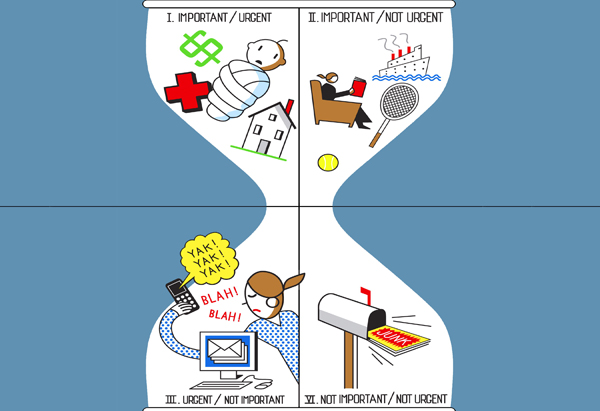
Illustration: Knickerbocker
About a year ago, I watched a speech online about time management given in 1998 by Randy Pausch, PhD, a professor at Carnegie Mellon University. Pausch cautioned listeners not to waste energy on activities that seem urgent but aren't important. Choose instead, Pausch suggested, to spend time on activities that are deeply important, even if they don't seem critical.
That was an excellent speech. It would become extremely poignant in 2006, when the then 45-year-old Pausch was diagnosed with pancreatic cancer. Watching another of his speeches online—the famous "Last Lecture" (now a best-selling book), in which he teaches his three young children how to make their dreams come true—I wondered if this time management expert sensed, even back in 1998, that he'd spend less time on earth than anyone wished.
Pausch's work and his personal story drive home a lesson we all know but frequently forget: To live richly and avoid regret, we must give priority to things of real importance. But in a world where everything from your BlackBerry to your car's oil filter to your grandmother is competing for your limited time, this requires deliberate, consistent choice. The good news is that we can develop the habit of choosing what's really important over everything else. Life seems designed to teach us how to do this. Pay attention, and you'll notice that even when you're under "urgent" pressure to do something unimportant, it feels discordant and wrong. Do what really matters, and your life comes into harmonious alignment. Don't believe me? Apply the concepts that follow, and call me in the morning.
To me, Stephen Covey will always be the smart, funny guy on my high school debate team who, when it was time to be cross-examined by an opponent, would drop the "c" from the traditional phrase "I'm now open for cross-ex," so that it came out "I'm now open for raw sex." The judges never noticed, and the rest of us debaters thought Steve was hilarious. We also sort of knew that his dad, Stephen Covey Sr., was a renowned management guru. Randy Pausch was quoting Steve's dad when he proposed categorizing all activities on a matrix of apparent urgency and ultimate importance, like this:

As Covey observed, we almost always do the things in Quadrant I (stuff that's both important and urgent, like feeding the kids and paying the rent), and almost never get to Quadrant IV (like reading junk mail). That's good. However, we tend to focus on Quadrant III (urgent but not important things, like talking to a demanding co-worker about her rotten boyfriend) to the detriment of Quadrant II (no-deadline pastimes like writing a book, basking in nature's beauty, or taking time to be still). Covey proposed devoting less time to the dinky tasks, even those that are urgent, and more time to those things that are really important.
Here's an exercise he proposed:
That was an excellent speech. It would become extremely poignant in 2006, when the then 45-year-old Pausch was diagnosed with pancreatic cancer. Watching another of his speeches online—the famous "Last Lecture" (now a best-selling book), in which he teaches his three young children how to make their dreams come true—I wondered if this time management expert sensed, even back in 1998, that he'd spend less time on earth than anyone wished.
Pausch's work and his personal story drive home a lesson we all know but frequently forget: To live richly and avoid regret, we must give priority to things of real importance. But in a world where everything from your BlackBerry to your car's oil filter to your grandmother is competing for your limited time, this requires deliberate, consistent choice. The good news is that we can develop the habit of choosing what's really important over everything else. Life seems designed to teach us how to do this. Pay attention, and you'll notice that even when you're under "urgent" pressure to do something unimportant, it feels discordant and wrong. Do what really matters, and your life comes into harmonious alignment. Don't believe me? Apply the concepts that follow, and call me in the morning.
First (and Second) Things First
To me, Stephen Covey will always be the smart, funny guy on my high school debate team who, when it was time to be cross-examined by an opponent, would drop the "c" from the traditional phrase "I'm now open for cross-ex," so that it came out "I'm now open for raw sex." The judges never noticed, and the rest of us debaters thought Steve was hilarious. We also sort of knew that his dad, Stephen Covey Sr., was a renowned management guru. Randy Pausch was quoting Steve's dad when he proposed categorizing all activities on a matrix of apparent urgency and ultimate importance, like this:
As Covey observed, we almost always do the things in Quadrant I (stuff that's both important and urgent, like feeding the kids and paying the rent), and almost never get to Quadrant IV (like reading junk mail). That's good. However, we tend to focus on Quadrant III (urgent but not important things, like talking to a demanding co-worker about her rotten boyfriend) to the detriment of Quadrant II (no-deadline pastimes like writing a book, basking in nature's beauty, or taking time to be still). Covey proposed devoting less time to the dinky tasks, even those that are urgent, and more time to those things that are really important.
Here's an exercise he proposed:
- Get 20 or 30 notecards. On each card, write down one thing you should do, want to do, hope to do, plan to do, or dream of doing. Include everything, no matter how large or small. Keep this up until your brain runs dry.
- When you've written down all your goals, plans, and ideas, separate the cards into two piles: things that have to be done right this minute (or feel like it) and those that don't.
- Now go through both of these piles, separating each into "important" and "not important" stacks. The four resulting stacks correlate with the Covey Quadrants.
- Carefully place both your "not important" card stacks in a safe spot. This, if my experience is any indication, will ensure that you'll never find them again. If you do happen to stumble across them at any time in the future, burn them.
- Commit to eliminating from your schedule all the activities that didn't make it into the "important" stacks. If you have time after doing your important and urgent things, use it on important but not urgent activities. No matter how pressing something may seem to be, if it's not important, just don't do it.

NEXT STORY

